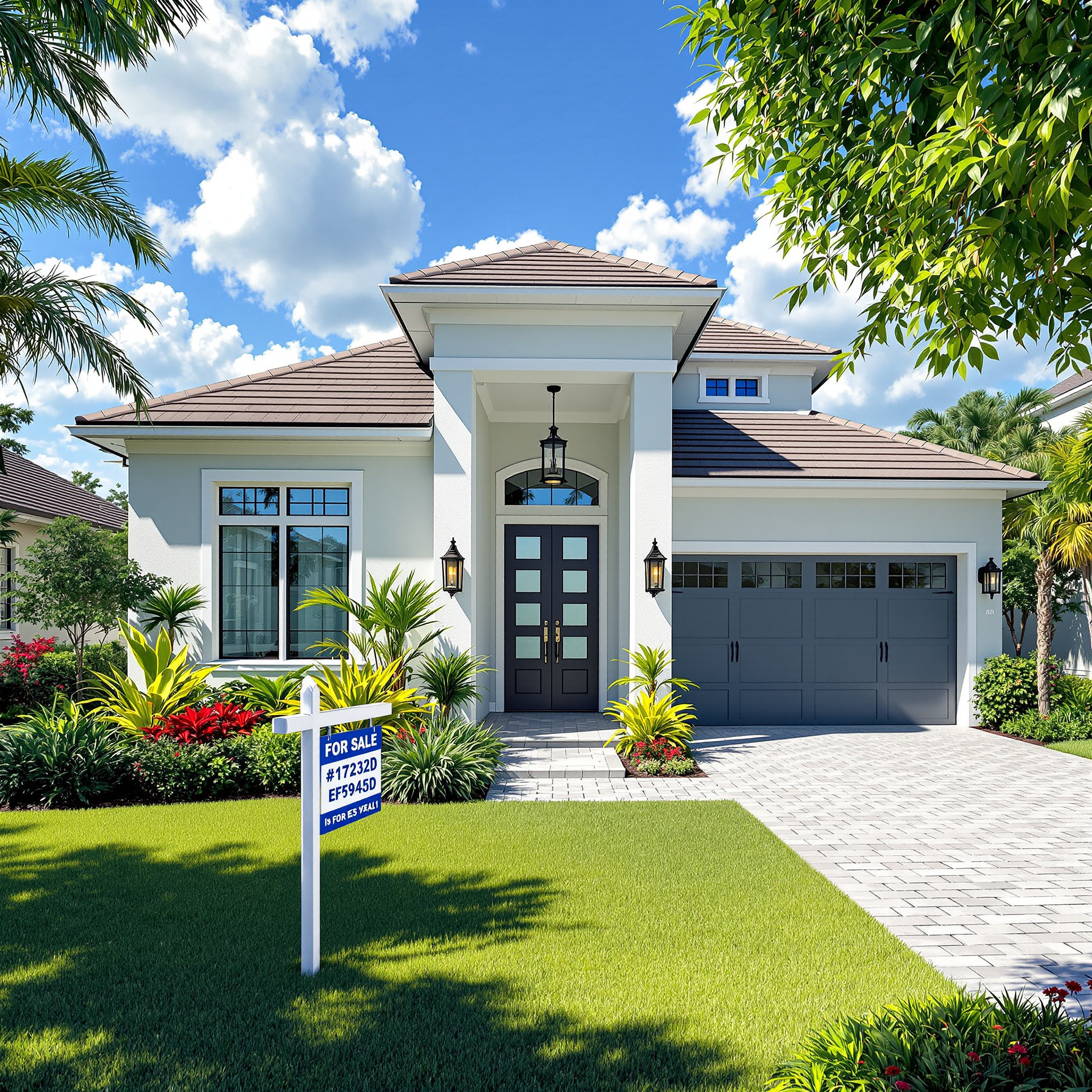
Florida’s real estate market is currently facing a complex situation marked by high prices and fluctuating demand. Inventory is increasing in many areas but remains below historical averages. Interest rates significantly impact affordability, and although rates have stabilized, they remain elevated compared to recent years. Population growth, while still positive, has slowed compared to the pandemic peak. The median sales price for existing single-family homes varies widely across the state, with some metropolitan areas experiencing price corrections while others remain relatively stable. Rising insurance costs and property taxes contribute to the overall cost of homeownership, further impacting affordability. Investor activity has decreased, shifting the market dynamic toward more traditional owner-occupant buyers.

Blog
“Someone posted that they had just made synonym buns. I replied, ‘You mean just like the ones that grammar used to make?’ I am now blocked.” That was sent to me by an economist; yes, they have senses of humor. Did you know that the Federal Reserve Board employs more than 500 researchers, including more than 400 Ph.D. economists, who represent an exceptionally diverse range of interests and specific areas of expertise? (I wonder if anyone yells, “Is there a doctor in the house?” at staff meetings.) This week’s focus will be almost entirely on the Federal Reserve. The central bank’s monetary policy committee will deliver its seventh interest rate decision of the year on Wednesday. The Fed has stubbornly held interest rates steady since ending 2024 with a series of cuts, but now with the labor market showing continued signs of cooling and inflation remaining sticky, it is a sure thing that the central bank will restart its policy easing process and drop overnight Fed Funds by 25 basis points, which in turn should move the discount rate lower (the rate at which the Federal Reserve lends money to financial institutions, including commercial banks, thrifts and credit unions). (Today’s podcast can be found here and this week’s are sponsored by CreditXpert. The all-new credit optimization platform that helps you close more loans. CreditXpert is committed to making homeownership more accessible and affordable for ALL. Today’s features an interview with Potomac Consulting’s Dan Varroney on why the Federal Reserve should cut rates 50-basis points this week due to weakening labor markets and recent inflation data.)
Florida mortgage rates generally follow national trends but can be slightly higher. As of late 2023 and early 2024, rates are fluctuating, influenced by Federal Reserve policy and economic indicators. 30-year fixed mortgage rates in Florida ranged from 6.5% to 7.5% during this period. Homebuyers should shop around for the best rates from multiple lenders, consider adjustable-rate mortgages (ARMs) if planning a short-term stay, and improve their credit score to secure lower interest rates. Rising rates impact affordability, potentially leading to lower demand and price stabilization, but specific local market conditions vary across Florida. Rising rates can increase monthly payments by hundreds of dollars for the average mortgage.
Florida’s real estate market presents flipping opportunities, but profitability depends on strategic planning. Average ROI on flips in Florida ranges from 5% to 20%, influenced by location, renovation budget, and holding costs. Key areas to focus on include: identifying undervalued properties through foreclosure lists or off-market deals; controlling renovation costs by pre-planning and securing multiple contractor bids (average renovation budget range is 10-20% of the purchase price); strategically staging and marketing the property to attract buyers. Holding costs, including property taxes and insurance, average 1-3% of the property value per year, impacting overall ROI. Data suggests properties near beaches and major urban centers like Miami and Tampa tend to yield higher returns, but also present higher initial investment. Understanding local market trends, zoning regulations, and permitting processes is crucial.
Florida’s real estate market faces shifting dynamics. Inventory is rising in many markets, slowing price appreciation. Interest rates impact affordability, tempering demand. Migration patterns, while still positive, are moderating compared to peak pandemic levels.
* **Inventory:** Increased significantly in many major metro areas (e.g., some cities see a 50%+ increase YOY).
* **Price Growth:** Slower price appreciation expected; some markets may see price corrections. Median sales prices may remain elevated compared to pre-pandemic, however.
* **Interest Rates:** High interest rates continue to be a headwind for buyers, affecting affordability.
* **Migration:** Florida’s population growth continues, but at a slower pace than 2020-2022.
* **Luxury Market:** While still active, the luxury market may experience increased negotiation power for buyers due to increased inventory.
* **Insurance Costs:** Rising insurance premiums remain a significant concern impacting affordability and buyer decisions.
* **Rental Market:** Rental rates may stabilize or see slight decreases in some areas due to increased supply of apartments and single-family rentals.
“Rob, we’ve said ‘no’ to more expansion possibilities than ever before. Are you hearing other lenders doing deep dives on LOs and branches and also not seeing a profitable path?” Yes indeedy. Here in Jackson, MS, at the Mississippi Mortgage Banker’s Fall Conference, lenders are not only discussing expansion but also early payoff penalties and strategies to avoid them. (Of course, they are explaining to newer entrants why few investors would ever pay 102 or 104 for a loan that may pay off soon at 100.) One topic is why companies service, or sell service, and this month’s STRATMOR piece is titled, “Servicing: What’s All the Fuss About?” Another topic on lenders’ minds are demographics, income, and reasons for moving, and now we have government news that income inequality has dipped and fewer people moved, per the largest survey of U.S. life. Talk to any solid loan originator, and they’ll tell you that the top three attributes of their brethren are focus, leadership, and consistency. (Today’s podcast can be found here and this week’s are sponsored by Indecomm. Streamlining operations with the genius blend of automation, AI, and services. Achieve practical digital transformation and real operational impact with Indecomm’s purpose-built mortgage solutions. Hear an interview with Polunsky Beitel Green’s Peter Idziak on takeaways from the bipartisan Home Buyers Privacy Protection Act (trigger leads bill), which amends the Fair Credit Reporting Act by shifting trigger leads to an opt-in system, mandates a study on text-based solicitations, and raises concerns about its impact on credit bureau revenue and market competition.)
Florida property values are assessed by County Property Appraisers, who use mass appraisal techniques, primarily the market (sales comparison), cost, and income approaches. Accuracy can vary significantly.
* **Sales Comparison Approach:** Relies on recent sales of comparable properties. Accuracy is best in homogenous neighborhoods with frequent sales.
* **Cost Approach:** Estimates value based on the cost to replace the property, minus depreciation. Often used for unique or newer properties.
* **Income Approach:** Used for income-producing properties, estimating value based on net operating income (NOI).
**Key Considerations impacting accuracy:**
* **Mass Appraisal Limitations:** Valuation of large numbers of properties simultaneously introduces inherent inaccuracies compared to individual appraisals.
* **Homestead Exemption:** Limits assessment increases to 3% annually, potentially creating a significant discrepancy between assessed and market value over time.
* **Market Volatility:** Rapid market changes (booms/busts) can quickly render assessed values outdated.
* **Neighborhood Specificity:** Broad averaging of comparable sales can lead to inaccuracies if neighborhood characteristics are not finely tuned.
* **Data Quality:** Errors in property data (size, features, condition) used in the valuation models impact accuracy.
* **Assessment Ratio:** The percentage of market value used for assessment. Florida law requires 100% for most properties. Discrepancies may arise.
* **Appeal Process:** Taxpayers have the right to appeal their assessed value if they believe it’s inaccurate.
* **Median Sale Price increase:** In 2022, Florida saw median sale price increases of over 20% in some counties, potentially leading to assessment lags.
It’s an interesting morning for economic data and the bond market’s reaction. At face value, CPI was mostly in line with forecasts, but unrounded numbers were a bit hot (i.e. core monthly CPI was 0.346%, almost high enough to make for a 0.4 vs 0.3 reading). Additionally, monthly headline inflation was 0.4 vs 0.3. These numbers, in and of themselves, wouldn’t seem to suggest a bond rally. At the same moment, Jobless Claims printed at 263k vs a 235k forecast–the highest reading since 2021. The initial conclusion is that there is enough labor market concern to offset still-elevated inflation, but a drop in supercore inflation (excludes food/energy/housing) may be the bigger factor. Last month’s supercore, per Bloomberg, was 0.481. This month, it fell to 0.330. This basically means inflation is standing aside and allowing the Fed to focus on the weaker labor market–a conclusion that’s far more informed by the last jobs report than today’s jobless claims.
Florida property values are influenced by factors like location, size, condition, age, and recent sales of comparable properties (comps). Accurately estimating requires considering both automated valuation models (AVMs) and professional appraisals. AVMs, like Zillow’s Zestimate, provide an initial range but can deviate significantly from actual market value; median error rates vary. Professional appraisals offer the most accurate estimate, costing typically $300-$500. Florida’s real estate market is dynamic; waterfront properties command premiums. Interest rate fluctuations and inflation influence affordability and demand. Homestead exemptions can reduce property tax burdens. Property taxes are calculated based on assessed value, factoring in millage rates. Local market conditions and community developments play a significant role in property values.
“Rob, I hate it when mom and dad fight. Will this Pulte/Bessent, FHFA/Treasury tussle impact mortgage rates?” Probably not; it hasn’t so far. Director Pulte is certainly in the news. Occupancy isn’t a partisan issue, right?! FHFA Director Pulte, who continues to point out potential fraud by Fed. Governor Lisa Cook (who a Federal judge ruled yesterday could stay in her post), has two close relatives who have declared the same owner-occupied status on two homes in two different states! Don’t blame me: read about it in CNBC and Reuters. “Mark and Julie Pulte, the father and stepmother of Bill Pulte, President Donald Trump’s appointee as director of the Federal Housing Finance Agency, since 2020 have claimed so-called ‘homestead exemptions’ for residences in wealthy neighborhoods in both Michigan and Florida…” What about news closer to regular lending? Chase launched some publicity with a limited-time “mortgage rate refinance sale.” The Chase promotion is on rate-and-term and cash-out refinances through Sunday, Sept. 21. Customers must lock in their refinancing rate during this period to earn the discount. How much of a discount? According to Chase, “Discounts will vary by mortgage product and location.” (Today’s podcast can be found here and this week’s are sponsored by Indecomm. Streamlining operations with the genius blend of automation, AI, and services. Achieve practical digital transformation and real operational impact with Indecomm’s purpose-built mortgage solutions. Hear an interview with MCT’s Phil Rasori on shifting coverage in response to policy and economic changes, to the expansion of ARM and non-QM products, the growing role of AI in hedging and analytics, evolving tech freeing up staff for strategic work, and the rising demands placed on modern capital markets departments.)
Recent Posts
- Jak System Punktów Lojalnościowych W Slottica Casino Wspiera Odpowiedzialną Grę
- Regulirano Igralnica S Pravnim Dovoljenjem ♡ Republika Slovenija Deposit & Play
- Experimentera Enorma Jackpottar – Gotlands län
- Florida Real Estate: Is Now the Right Time to Buy or Sell?